The most important thing to understand about emerging real estate markets in Nigeria is also the most uncomfortable: by the time a location is widely described as a hotspot, the easiest money has usually already been made. Ikoyi was a bush in the 1970s. Lekki Phase 1 was a bold bet in the 1990s. Victoria Garden City was agricultural land before it became one of Lagos’s most prestigious addresses. The investors who built real wealth from those locations were not the ones who bought after the roads were paved and the signboards went up. They were the ones who read the signals — infrastructure commitments, government land releases, population pressure, economic activity — and moved before consensus formed.
Nigeria’s real estate market in 2026 is at exactly that kind of inflection point in multiple locations simultaneously. Rapid urbanisation, persistent housing shortages, major infrastructure projects, Lagos spillover pressure, and an increasingly sophisticated diaspora investor base are combining to create genuine appreciation opportunities in corridors that have not yet priced in their own potential. This guide identifies the locations where those opportunities currently exist, explains the specific drivers behind each one, and sets out the honest risks that any investor must account for.
The fundamental principle that distinguishes real hotspots from marketed “hopspots” is measurable, on-the-ground development: not developer promises, not projected airport announcements, but actual infrastructure investment already taking place, actual population growth already happening, and actual economic activity already creating demand. Every location in this guide meets that standard.
At a Glance: Nigeria’s Top Emerging Hotspots (2026)
| Hotspot | State | Best For | Entry Price | Key Driver |
| Ibeju-Lekki | Lagos | Appreciation / dev. | Mid–High | Dangote Refinery; Deep Sea Port |
| Epe | Lagos | Land banking / resi. | Low–Mid | Airport; expressway; LFTZ |
| Mowe-Ofada | Ogun | Budget land banking | Very Low | Lagos spillover; ~30% annual growth |
| Ikorodu | Lagos | Residential / industrial | Low | Lagos proximity; warehousing demand |
| Ibadan (Moniya/Apata) | Oyo | Affordable resi. / yields | Low | Lagos spillover; rail link |
| Asaba | Delta | Mid-term residential | Low–Mid | South-South hub; bridge access |
| Enugu | Enugu | SE diaspora; mid-yield | Low–Mid | Urbanisation; infrastructure |
| Guzape / Katampe Ext. | FCT | Luxury / diplomatic | High | Phase 1 scarcity; govt. investment |
1. Ibeju-Lekki, Lagos — The Transformation Corridor
Ibeju-Lekki is the most discussed emerging real estate corridor in Nigeria and, arguably, the most consequential infrastructure story in the country’s recent history. The cluster of projects concentrated in this corridor is extraordinary in both scale and economic significance: the Dangote Refinery — currently the world’s largest single-train petroleum refinery — is operational. The Lekki Deep Sea Port, Nigeria’s first fully automated deep-water port, is receiving vessels. The Lekki Free Trade Zone is actively operational. And the proposed Lekki International Airport, if delivered, would complete a transformation of this corridor from agricultural backwater to industrial city.
The investment case for Ibeju-Lekki rests not on future promises but on present reality. These projects are not announcements — they are operational. Every operational project creates jobs, and every job creates a worker who needs housing, food, transport, healthcare, and services. That demand feeds directly into the residential and commercial property market. Land that was available for small sums a decade ago has already appreciated dramatically, and analysts project continued appreciation as the workforce expands and urban services follow the economic activity.
| 📊 Ibeju-Lekki Investor SnapshotKey drivers: Dangote Refinery (operational), Lekki Deep Sea Port (operational), LFTZ, proposed airportBest for: Medium-to-long-term land banking; residential development for workers’ housingRisk: Project delay risk on airport; title verification is critical — many plots have defective documentationEntry: Still accessible relative to potential, but significantly above 2018–2020 pricesInvestor tip: Prioritise plots with verified C of O or gazette-based excision, not family land or informal allocation |
2. Epe, Lagos — Affordable Gateway to the Lekki Corridor
Epe is the quieter sibling of the Ibeju-Lekki story — less discussed, more affordable, and in some respects offering a cleaner entry point for investors who want exposure to the Lekki-Epe growth corridor without paying Ibeju-Lekki prices. Traditionally known for its fish markets and agricultural character, Epe is being transformed by the same infrastructure tailwinds that are reshaping the entire eastern Lagos corridor: the Lekki-Epe Expressway, proximity to the Lekki Free Trade Zone, and the proposed international airport in the Lekki zone.
Land prices in Epe remain relatively affordable by southern Lagos standards, and the area’s serene environment and developing amenities make it attractive for both residential development and commercial investment. For investors targeting end-users rather than pure capital appreciation, Epe offers a more mature residential fabric than many parts of Ibeju-Lekki, with existing markets, schools, healthcare facilities, and a functioning local economy. The risk profile is lower than the furthest reaches of the Ibeju-Lekki corridor, and the yields from established residential stock are beginning to reflect genuine market demand rather than speculative premiums.
3. Mowe-Ofada, Ogun State — Lagos Spillover at Maximum Velocity
Mowe-Ofada has emerged as one of the most dramatically active land markets in Nigeria, driven almost entirely by Lagos spillover demand from buyers and developers priced out of the Lagos mainland. Located along the Lagos-Ibadan Expressway in Ogun State, the corridor is experiencing annual land value appreciation estimated at approximately 30 per cent per year by 2026 analysts — a figure that, if sustained, represents one of the fastest capital growth rates of any real estate market in West Africa.
The mechanics are straightforward: as Lagos’s land prices rise, demand migrates to the nearest affordable alternative with reasonable expressway connectivity. Mowe-Ofada fits that description almost perfectly. The Lagos-Ibadan Expressway rehabilitation has dramatically improved commute times, and the ongoing rail corridor development adds another connectivity layer that further supports residential demand. Ogun State’s introduction of an e-Consent rule in 2026 has brought some transparency to land transactions in the corridor, reducing (though not eliminating) the title risk that has historically complicated investment in this area. Budget entry points for 300-500 square metre plots remain accessible at under ₦10 million in many sub-areas, making this the most accessible price-point hotspot on this list.
4. Ikorodu, Lagos — The Industrial and Residential Convergence
Ikorodu has long been treated as Lagos’s unglamorous northern mainland suburb — too far, too industrial, too far outside the Island-centric frame through which Lagos’s property market has traditionally been assessed. That characterisation is becoming increasingly outdated. Ikorodu is now one of Lagos’s fastest-growing property markets, driven by a convergence of residential demand from mainland professionals seeking affordable housing and industrial demand from warehouse and logistics operators who need large-footprint space close to Lagos’s northern transport corridors.
The residential opportunity is straightforward: Lagos’s chronic housing shortage is pushing demand steadily northward, and Ikorodu’s relative affordability — with entry-level plots available at prices significantly below comparable options on the mainland and island — makes it attractive for first-time buyers and developers targeting the mass-market residential segment. The industrial opportunity is arguably more interesting for investors with larger capital: Ikorodu sits at the intersection of major road and waterway routes, and the demand for quality warehouse and distribution space in the corridor is genuine and growing. Land banking in Ikorodu with a two-to-five-year horizon has produced strong returns for investors who entered the market in the early 2020s.
5. Ibadan — The Lagos Overflow City Finding Its Own Momentum
Ibadan has been described as a Lagos spillover market for so long that analysts are beginning to question whether the description is still accurate — because the city appears to be building genuine economic momentum of its own. Areas like Moniya, Apata, and the Ido axis are seeing steady residential development catering to workers, students, and families, driven by a combination of Lagos overflow demand, University of Ibadan-adjacent activity, and a growing manufacturing and distribution base that the city’s road and rail connectivity is increasingly capable of supporting.
For investors, Ibadan’s appeal is fundamentally about the risk-return profile. Entry prices for residential land and completed properties are among the lowest of any significant southern Nigerian city, while rental demand from the large student and young professional population provides consistent income yields. The Lagos-Ibadan Expressway rehabilitation and the expanding rail service between the two cities have measurably shortened effective commute times, which directly expands the pool of Lagos-based buyers willing to consider Ibadan for residential purchase or investment. This is an early-growth market with strong demand fundamentals and a manageable risk profile — the combination that typically produces the most reliable long-term returns.
6. Asaba, Delta State — The Quiet South-South Hub
Asaba has quietly built a compelling case as one of Nigeria’s most strategically positioned emerging real estate markets outside the Lagos-Abuja axis. As the capital of Delta State and a significant commercial centre in the South-South region, Asaba benefits from its location along major transport routes, its role as a gateway to oil-producing communities in the Niger Delta, and the commercial activity generated by the Onitsha bridge crossing — one of the most heavily trafficked transport nodes in southern Nigeria.
Residential demand in Asaba is driven by a stable base of professionals, government workers, and families seeking quality housing without the congestion and cost of mega-city living. Property values remain accessible relative to Lagos and Abuja, and the rental market is consistent. For investors targeting the South-South region, Asaba offers a lower-risk entry point than Port Harcourt’s more volatile, oil-dependent market, with stronger institutional stability and improving infrastructure under the Delta State government’s capital investment programme.
7. Enugu — Southeast Nigeria’s Most Reliable Growth Corridor
Enugu is experiencing a real estate boom driven by urbanisation, an influx of businesses, and a growing diaspora returnee community investing in the Southeast. The city’s peaceful environment — consistently one of its strongest differentiators relative to other southern Nigerian cities — combined with measurable improvements in road infrastructure and public facilities, is attracting investors and end-users who might previously have defaulted to Lagos or Abuja.
Five years ago, outer areas of Enugu that are now seeing active development were considered too remote from the city centre to justify investment. Today, those same areas are posting significant appreciation as connecting roads have been completed and estate development has followed. Infrastructure improvements connecting previously remote areas to the city centre, government investment in roads and utilities, and a growing middle class seeking affordable property with appreciation potential are combining to produce returns that savvy investors are quietly capitalising on. The diaspora dimension is particularly important: Nigerians returning from the UK, US, and Europe are increasingly choosing Enugu as a base, and their capital and standards are driving up specification levels and market prices in the city’s better-performing corridors.
8. Guzape and Katampe Extension, Abuja — Phase 1 Scarcity Premium
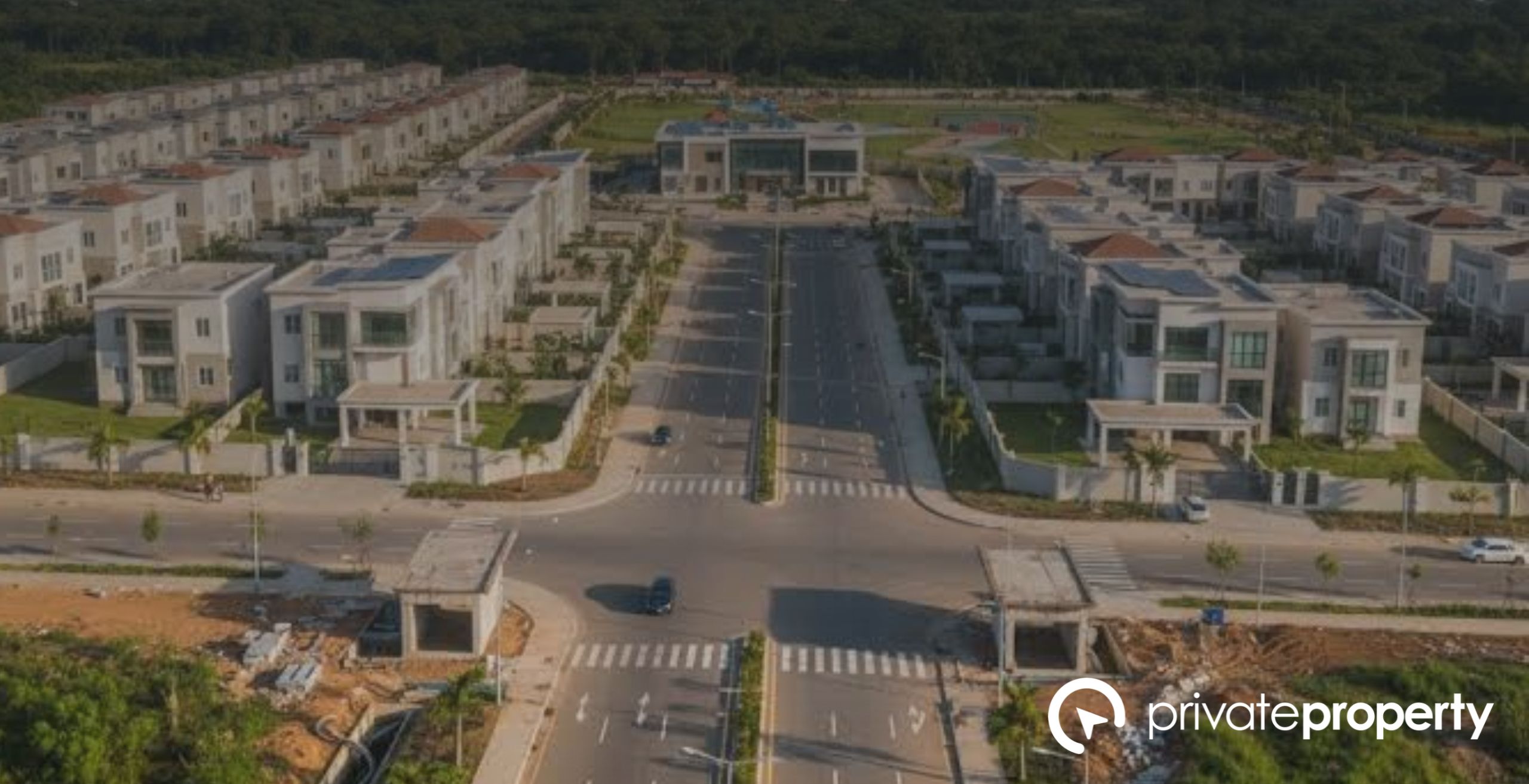
Within Abuja’s FCT, the most active appreciation is concentrated in Guzape and Katampe Extension — the two remaining developing districts within the city’s Phase 1 boundary. Both offer a combination of inner-city prestige, dramatic topography with panoramic city views, active government infrastructure investment, and prices that remain measurably below the fully built-out Phase 1 districts of Maitama and Asokoro. Guzape is flagged by 2026 market analyses as one of the FCT’s top appreciation corridors, with road and infrastructure upgrades under the Outer Southern Expressway programme actively lifting nearby asking prices. Katampe Extension’s diplomatic zone designation attracts institutional-quality demand from embassies and multinational corporations, providing an income stability floor that most residential markets cannot match.
How to Tell a Real Hotspot from a Marketed One
Nigeria’s real estate marketing ecosystem has a well-documented tendency to label every new estate development as a “hotspot” regardless of underlying fundamentals. Many marketed hotspots remain undeveloped years later because growth requires more than promotional materials. The distinction between real and false hotspots comes down to a short checklist:
Is there actual infrastructure investment already happening? Not announced, not planned, not “under discussion” — actually happening. Roads being paved, ports receiving vessels, factories hiring workers, rail lines being laid. If the only evidence of growth is a developer’s brochure, that is not a hotspot.
Is economic activity creating real jobs? Population growth and housing demand follow employment, not the other way around. A location where people are moving because jobs exist is a real hotspot. A location where people are expected to move “when the projects come” may not be.
Does the location have road access that functions today? Inaccessible locations with poor road connections fail as investment locations regardless of what is promised. Visit in person, drive the road in the rainy season, and assess whether the infrastructure that exists today is adequate for the use case you are investing in.
Are you buying with a verified title? This is non-negotiable in any emerging market. Hotspot areas attract Omonile fraud and title irregularities. Verify every title through the relevant registry (LASLIS in Lagos, AGIS in Abuja) before any payment. A speculative bet on land with a questionable title is not investment — it is a lottery ticket.
Final Thoughts: The Window Is Open, But It Is Closing
Nigeria’s emerging real estate hotspots share a common characteristic: they are all in the process of becoming something, rather than having already arrived. That developmental phase is precisely where the best investment returns are generated — before prices fully reflect what the location is going to be, while the infrastructure investment that will drive those prices is already visibly under way.
The locations in this guide — Ibeju-Lekki, Epe, Mowe-Ofada, Ikorodu, Ibadan, Asaba, Enugu, Guzape, and Katampe Extension — are all at different stages of that developmental curve. Some, like Ibeju-Lekki, are already well past the earliest entry point and now offer a more measured, evidence-based appreciation thesis. Others, like parts of Ibadan’s expanding corridors and Mowe-Ofada, are still early enough that patient investors with a three-to-five-year horizon can capture the most significant appreciation window.
What every location on this list shares is the fundamental condition that separates real opportunity from speculation: measurable, on-the-ground development is happening now. The smart money is already moving. The question, as always in real estate, is whether you move with it while the window is still open.